
Your digital storefront acts as the final hurdle in the sales funnel for Australian businesses. A well-structured layout often determines whether a visitor becomes a loyal client or simply clicks away.
By analyzing various website pricing page examples, you can learn how to present your value clearly. Strategic design choices help build trust and guide potential buyers toward a confident decision.
Clarity is the cornerstone of modern web development. When you simplify your tiers, you remove friction and encourage higher conversion rates across your entire platform.
Key Takeaways
- A clear layout is essential for converting visitors into paying customers.
- The checkout area serves as the most critical stage of the sales funnel.
- Strategic design helps build immediate trust with your target audience.
- Simplifying your tiers reduces friction during the final buying process.
- Effective digital storefronts prioritize user experience to boost revenue.
The Strategic Importance of a Well-Designed Pricing Page
A well-structured pricing page serves as the silent salesperson for your business, guiding visitors toward a confident purchase. It is the bridge between interest and commitment, making it a vital component of your digital sales funnel. By utilizing a comprehensive website pricing guide, businesses can transform this page from a simple list of costs into a powerful conversion engine.
Psychology of Pricing and User Trust
Consumers often rely on mental shortcuts when evaluating costs. When you present your services clearly, you reduce the cognitive load on your potential clients, which fosters immediate trust. Transparency is the cornerstone of this relationship.
“Price is what you pay. Value is what you get.” — Warren Buffett
To build lasting credibility, consider these psychological factors:
- Anchoring: Displaying a premium option first can make your mid-tier plans seem like a better value.
- Simplicity: Avoid overwhelming users with too many choices, as this often leads to decision paralysis.
- Clarity: Ensure that all hidden costs are visible to prevent frustration during the checkout process.
Aligning Pricing Models with Business Goals
Selecting the right website pricing models is not just about revenue; it is about long-term sustainability. Your pricing structure should reflect your specific business objectives, whether you are aiming for rapid market penetration or high-margin service delivery.
Effective website pricing strategies require a balance between profitability and customer accessibility. By aligning your costs with the perceived value of your services, you ensure that your business remains competitive in the Australian market. This strategic alignment helps you attract the right type of client while maintaining healthy profit margins for future growth.
Essential Elements of High-Converting Pricing Pages
Your pricing page serves as the final bridge between a curious visitor and a loyal customer. When potential clients reach this stage, they are often looking for validation that your solution fits their budget and needs. If your page is confusing or lacks direction, you might find yourself wondering why is my website not getting despite having high traffic.
Clear Value Propositions and Tiered Structures
A successful pricing layout relies on simplicity and logical flow. Users should immediately understand what they are paying for without needing to hunt for details. By utilizing a tiered structure, you allow customers to compare options side-by-side, which helps them identify the plan that best aligns with their specific requirements.
Effective design avoids overwhelming the visitor with too many choices. Instead, highlight a “recommended” or “most popular” tier to guide decision-making. This subtle nudge reduces cognitive load and helps users feel more confident in their final selection.
The Role of Social Proof and Trust Badges
Buyer anxiety is a common hurdle in the digital sales process. You can mitigate this by integrating social proof directly into your pricing table. Displaying client testimonials, industry awards, or partner logos reinforces your brand credibility and builds immediate rapport with new visitors.
Trust badges, such as security certifications or money-back guarantees, act as visual cues that reassure users their transaction is safe. When people feel secure, they are significantly more likely to proceed to checkout. Transparency in these elements is key to turning a hesitant browser into a paying client.
Call to Action Optimization for Australian Markets
Optimizing your call-to-action (CTA) buttons is essential for maximizing click-through rates within the Australian market. Local consumers appreciate clear, direct, and action-oriented language. Avoid generic phrases like “Submit” and opt for more compelling options such as “Get Started,” “Start Your Free Trial,” or “Book a Consultation.”
Ensure your buttons stand out visually through the use of contrasting colors and generous whitespace. In a competitive digital landscape, your CTA must be the most prominent element on the page. By focusing on these structural components, you create a seamless path that encourages users to take the next step with your business.
Curated Website Pricing Page Examples for Inspiration
Finding the right balance between information density and user experience is a common challenge for digital teams. By analyzing successful website pricing page examples, you can learn how to guide potential clients toward the right choice without causing decision fatigue. Effective designs prioritize visual hierarchy to ensure that the most important details remain front and center.
SaaS Pricing Page Layouts
Software-as-a-Service companies often rely on tiered structures to cater to different user needs. The most effective layouts use a three-column design to highlight a “recommended” plan, which helps anchor the user’s expectations. These best pricing page examples typically include:
- Clear feature comparison tables that highlight technical specifications.
- Prominent toggle switches for monthly versus annual billing cycles.
- Strong, high-contrast call-to-action buttons for each tier.
Service-Based Business Pricing Displays
For service providers, the goal is to build trust while managing expectations regarding project scope. Many successful businesses use a “starting at” pricing model to prevent sticker shock while encouraging direct inquiries. This approach allows for flexibility when quoting complex, bespoke projects for Australian clients.
By using a clean, minimalist layout, you can present your services as an investment rather than a simple commodity. Transparency remains the key factor here, as it helps filter out unqualified leads before they reach your inbox.
E-commerce Subscription Model Examples
Subscription-based e-commerce sites thrive on simplicity and the promise of recurring value. These pages often focus on the convenience of automated delivery, using imagery to show exactly what the customer receives each month. High-converting designs emphasize the total savings gained by choosing a subscription over a one-time purchase.
When designing your own page, consider how these best pricing page examples utilize whitespace to keep the focus on the product. A well-structured layout ensures that your customers feel confident in their decision to commit to a long-term plan.
Implementing a Website Cost Calculator for Better Engagement
A website cost calculator transforms a static pricing page into a dynamic, high-engagement asset for your brand. By allowing users to input their specific requirements, you move away from generic lists and toward a personalized digital experience. This shift reflects the growing demand for transparency and immediate value in the Australian market.
Benefits of Interactive Pricing Tools
Interactive tools provide instant, actionable data that keeps visitors on your site longer. When a potential client can visualize the cost of their project in real-time, they feel more in control of their purchasing journey. This level of interactivity significantly reduces friction and builds immediate trust with your audience.
“The future of digital sales lies in empowering the customer to self-educate through intuitive, data-driven interfaces.”
Technical Considerations for Calculator Integration
Integrating a website cost calculator into your existing content management system requires careful planning. You must ensure that the tool is mobile-responsive and loads quickly to prevent bounce rates. Developers often use JavaScript frameworks or dedicated plugins to ensure the calculator communicates effectively with your backend systems.
It is essential to maintain a consistent design language so the tool feels like a native part of your site. If you are unsure about the best approach for your specific platform, reviewing professional pricing page strategies can provide the necessary technical guidance. Proper API connectivity ensures that the data captured is accurate and useful for your internal reporting.
Improving Lead Quality Through Self-Service Tools
Self-service tools act as a powerful filter for your sales pipeline. By the time a prospect reaches out to your team, they are already educated on your typical price ranges and service tiers. This process ensures that your sales staff spends their time on high-intent leads rather than answering basic questions.
Ultimately, providing a website cost calculator demonstrates that your business values the user’s time. This transparency helps align expectations early, leading to higher conversion rates and more satisfied clients. By prioritizing user-centric design, you create a sustainable competitive advantage in your industry.
Best Practices for Creating a Pricing Page
Effective pricing page design ideas can transform how your audience perceives your brand value. When you are creating a pricing page, the primary goal is to balance aesthetic appeal with functional clarity. This ensures that potential customers can make informed decisions without feeling overwhelmed by technical jargon or cluttered layouts.
Simplifying Complex Service Offerings
Many businesses struggle to present intricate service packages in a way that is easy to digest. You should focus on distilling your offerings into clear, distinct tiers that highlight the specific benefits of each level. By using concise language, you help users quickly identify which plan aligns with their unique needs.
If you need further guidance on structuring these tiers, exploring pricing page best practices can provide the necessary framework. Simplification is the key to reducing friction during the final stages of the buyer’s journey.
Mobile Responsiveness and Accessibility Standards
In the Australian market, a significant portion of web traffic originates from mobile devices. Your site must be fully responsive, ensuring that buttons are easy to tap and text remains legible on smaller screens. Accessibility is equally vital, as it ensures that all users, including those with disabilities, can navigate your pricing information effectively.
Adhering to these standards is not just a legal consideration; it is a fundamental aspect of good user experience. When you prioritize inclusivity, you broaden your reach and build deeper trust with your audience.
Visual Hierarchy and Whitespace Usage
The strategic use of whitespace allows your most important information to stand out. By giving your pricing tiers room to breathe, you prevent visual fatigue and guide the user’s eye toward your primary call-to-action buttons. Visual hierarchy ensures that the most valuable plan receives the most attention.
Consider the following table to understand how different design elements impact user engagement and conversion rates:
| Design Element | Primary Benefit | Impact on Conversion |
|---|---|---|
| Whitespace | Reduces cognitive load | High |
| Color Contrast | Highlights CTA buttons | Very High |
| Tiered Layout | Simplifies decision making | High |
| Mobile Scaling | Improves accessibility | Medium |
Common Mistakes to Avoid in Pricing Page Design
A poorly structured pricing page can often be the reason why your website gets traffic but no enquiries. When visitors arrive at your site, they expect a seamless experience that guides them toward a decision. If your layout is confusing or lacks essential information, you risk losing them to a competitor.
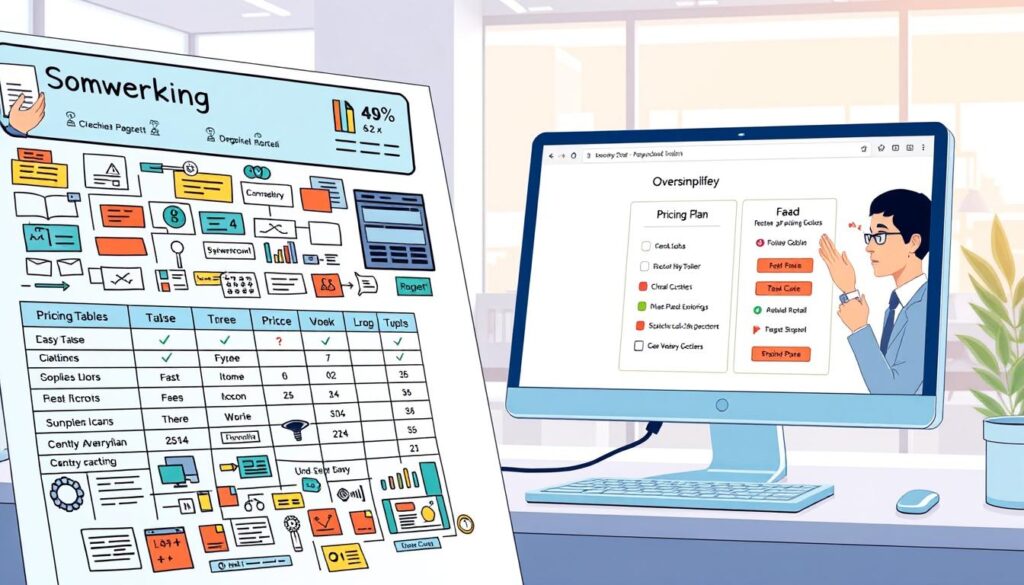
Overwhelming Users with Too Many Options
Decision paralysis is a real phenomenon in digital marketing. When you present too many tiers or complex add-ons, users often struggle to choose, leading them to abandon the page entirely. Keep your offerings simple to ensure that potential clients can quickly identify the plan that best fits their specific needs.
Focus on highlighting the most popular choice to guide the user’s journey. By limiting the number of choices, you reduce the cognitive load and help the visitor feel more confident in their final selection.
Lack of Transparency in Hidden Costs
Trust is the foundation of every successful business relationship. Nothing destroys that trust faster than discovering unexpected fees during the final checkout process. Transparency is not just a best practice; it is a necessity for maintaining a professional reputation.
“Transparency is the only path to building long-term customer loyalty in a digital-first economy.”
Always disclose all costs upfront, including setup fees or recurring charges. When customers know exactly what they are paying for, they are far more likely to complete the transaction without hesitation.
Ignoring Local Currency and Tax Requirements
For businesses operating within Australia, failing to display prices in AUD is a significant oversight. Consumers expect to see pricing that reflects their local market, including clear information regarding GST compliance. Ignoring these details can make your brand appear disconnected or unreliable to local prospects.
Ensure that your pricing page clearly states whether taxes are included in the displayed figures. Providing this level of clarity demonstrates that you respect your customers’ time and understand the regulatory environment in which you operate.
Choosing the Right Website Pricing Template
When you decide on a website pricing template, you are essentially setting the stage for your customer’s purchasing journey. This foundational choice impacts how quickly users understand your offerings and how likely they are to convert. Making an informed decision requires looking at both your current operational capacity and your long-term growth objectives.
Custom Design Versus Pre-Built Templates
Choosing between a bespoke design and a pre-built solution often comes down to your budget and specific functional requirements. Pre-built options offer speed and cost-efficiency, allowing you to launch quickly without extensive development time. However, they may lack the unique flair needed to stand out in a crowded Australian market.
Custom designs provide complete control over the user experience and visual storytelling. While they require a higher initial investment, they ensure that your pricing structure aligns perfectly with your brand’s specific needs. Consider the following comparison to help guide your decision:
| Feature | Pre-Built Template | Custom Design |
|---|---|---|
| Implementation Speed | Fast | Slow |
| Cost | Low | High |
| Brand Alignment | Limited | Full |
Balancing Brand Identity with Conversion Goals
Your pricing page must act as a seamless extension of your brand identity. Even when using a standard website pricing template, you should prioritize consistent typography, color palettes, and tone of voice. This consistency builds essential trust with potential clients who are evaluating your services.
Conversion goals should always dictate the layout of your page. You must ensure that your primary call-to-action buttons are prominent and that the hierarchy of information guides the user toward the most profitable tier. A well-balanced page feels like a natural part of your site rather than an isolated sales tool.
Scalability for Growing Australian Businesses
As your business expands, your pricing model will likely become more complex. You need a solution that can grow alongside your service offerings without requiring a complete site overhaul. Scalability is a key factor for any successful website pricing template, ensuring you can add new tiers or features as your market reach increases.
- Modular Layouts: Choose designs that allow for easy addition of new pricing columns.
- Responsive Frameworks: Ensure the template adapts gracefully to mobile devices as traffic grows.
- Integration Capabilities: Verify that the template supports future connections to CRM or payment gateways.
By focusing on these elements, you create a robust foundation that supports your business today while remaining flexible for tomorrow. Investing time in this selection process prevents technical debt and keeps your sales funnel running smoothly.
Professional Assistance for Your Pricing Strategy
Building a high-converting digital storefront requires more than just basic web development skills. It demands a deep understanding of consumer behavior and the technical precision to turn visitors into loyal customers. When you explore various pricing page examples, you quickly realize that professional design is the bridge between a simple list of costs and a persuasive sales tool.

Why Expert Web Design Matters for Conversions
Expert design ensures that your pricing structure is not only visually appealing but also psychologically optimized. Professionals understand how to use whitespace, color psychology, and hierarchy to guide the user’s eye toward your most profitable tiers. Strategic layout choices significantly reduce friction, making it easier for potential clients to make an informed decision without feeling overwhelmed.
A well-crafted page acts as a 24/7 sales representative for your business. By focusing on clarity and trust, expert designers help you:
- Highlight key benefits through clear, concise copy.
- Create a seamless mobile experience that works on any device.
- Implement trust signals that validate your brand’s authority.
- Optimize call-to-action buttons for maximum click-through rates.
How RH Designs Can Elevate Your Digital Presence
RH Designs specializes in transforming standard websites into high-performing assets tailored to the Australian market. We focus on creating bespoke solutions that align perfectly with your unique business goals and brand identity. Our team understands that every industry has different needs, and we pride ourselves on delivering customized strategies that drive measurable growth.
We believe that your pricing page should be a reflection of your commitment to quality. By partnering with us, you gain access to industry-leading design principles that prioritize user experience and conversion optimization. Our goal is to ensure your digital presence stands out in a crowded marketplace while maintaining a professional and trustworthy image.
Contacting RH Designs at 0431 367 724 or info@rh-designs.com.au
If you are ready to take your pricing strategy to the next level, our team is here to help. We invite you to reach out for a consultation to discuss how we can refine your website for better results. You can contact us directly to start the conversation about your project requirements.
Getting in touch is simple and straightforward. You can reach our dedicated support team through the following channels:
- Phone: Call us at 0431 367 724 to speak with a design expert.
- Email: Send your inquiries to info@rh-designs.com.au for a prompt response.
Conclusion
A well-designed pricing page serves as the cornerstone of a successful digital sales strategy for any Australian business. By prioritizing clarity and user experience, you transform a simple list of costs into a powerful tool for conversion.
You can gain deeper insights into effective layouts by reviewing pricing page examples for upgrading your SaaS to see how industry leaders structure their offers. These models demonstrate how to balance feature lists with clean, accessible design choices that guide visitors toward a purchase.
Commit to consistent testing and refinement to maintain a competitive edge in your specific industry. Small adjustments to your call-to-action buttons or the way you display currency can lead to significant improvements in your bottom line.
Professional designers at RH Designs remain ready to assist if you need further help optimizing your online presence for maximum impact. Reach out to the team at 0431 367 724 or send an email to info@rh-designs.com.au to start refining your strategy today.
FAQ
Why are specific website pricing strategies critical for converting Australian customers?
Effective website pricing strategies serve as the final hurdle in the sales funnel. For Australian businesses, clarity and transparency are paramount to overcoming buyer hesitation. By studying best pricing page examples from industry leaders like Atlassian or Canva, companies can learn how to present costs in a way that builds immediate trust and aligns with local market expectations regarding GST and currency transparency.
How can a website cost calculator improve the quality of my leads?
Implementing a website cost calculator significantly increases user engagement by providing real-time, personalized estimates. This interactive tool acts as a self-service filter, educating prospects on the value of your services before they ever speak to a sales representative. By the time a lead reaches out to a team like RH Designs, they already have a realistic understanding of the investment required, which streamlines the conversion process.
What should I look for when choosing a website pricing template?
When selecting a website pricing template, it is essential to find a balance between your unique brand identity and proven conversion layouts. A high-quality template should offer a mobile-responsive design, clear visual hierarchy, and the scalability needed for a growing business. Whether you choose a pre-built solution or a custom design, ensure it allows for easy updates to your website pricing models as your service offerings evolve.
What are some essential pricing page design ideas for SaaS businesses?
Some of the most effective pricing page design ideas include using tiered structures—such as “Basic,” “Professional,” and “Enterprise”—to cater to different user needs. Successful SaaS companies like Slack and HubSpot often highlight a “Most Popular” tier to guide decision-making. Additionally, incorporating whitespace and clear value propositions helps simplify complex data, making it easier for users to compare features at a glance.
How does this website pricing guide recommend building trust with potential buyers?
Building trust is achieved through transparency and the strategic use of social proof. This website pricing guide emphasizes the importance of including trust badges, client testimonials, and clear refund policies near the “Call to Action” buttons. By reducing buyer anxiety through logical cost presentations and visible third-party endorsements, you reinforce your brand’s credibility during the most critical stage of the user journey.
What are the most common mistakes to avoid when creating a pricing page?
When creating a pricing page, businesses often fail by overwhelming users with too many options or hiding additional fees until the final checkout. Another common pitfall is ignoring local requirements, such as displaying prices in AUD for Australian consumers. Avoiding these errors by maintaining a clean visual hierarchy and providing a straightforward cost breakdown is essential for maintaining a professional and reliable online presence.
Where can I get professional help to optimize my website’s conversion rates?
For businesses looking to elevate their digital storefront, professional assistance can make a significant difference. RH Designs specializes in creating high-converting pricing pages tailored to the Australian market. You can contact their expert team for a consultation by calling 0431 367 724 or emailing info@rh-designs.com.au to ensure your website pricing page examples are turned into a functional reality for your brand.